
UW Biology Greenhouse: Seattle’s Hidden Campus Rainforest
The UW Biology Greenhouse opens its doors to walk-in visitors twice a week, and most people who've lived in Seattle for years have never set foot inside it.
In this article
The UW Biology Greenhouse opens its doors to walk-in visitors twice a week, and most people who’ve lived in Seattle for years have never set foot inside it.
Ask a University of Washington biology grad student where to take an out-of-town guest without spending a dime, and there’s a decent chance they’ll skip the Washington Park Arboretum and send you underground instead — literally. The Biology Greenhouse sits on the lower level of the Life Sciences Building, and the collection has supported UW’s plant research and teaching for close to 70 years. What visitors walk into today is a 2021 rebuild: a 20,000-square-foot, LEED-certified facility split into nine climate-controlled bays, four of them open to the public.
No ticket. No suggested donation. No membership upsell at the exit. If you’re building a list of things to do near the University of Washington that don’t cost anything, this is the one most people drive right past.
What to Expect Inside
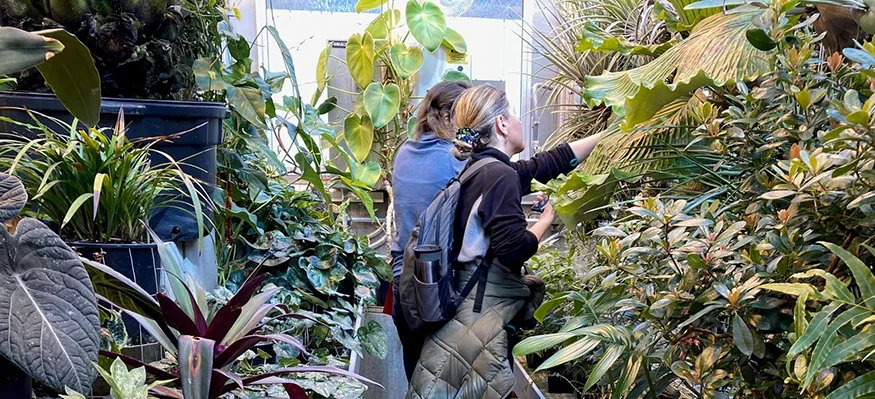
The greenhouse doesn’t announce itself. You come down a flight of stairs on the southwest side of the Life Sciences Building, past lab hallways that smell faintly of hand sanitizer and printer toner.
Then a door opens, and the air changes completely.
It’s warmer immediately — noticeably, physically warmer — and thick with the smell of wet soil and green growth. Condensation beads on the glass panels overhead. Somewhere, a humidifier hisses on a cycle you can’t quite predict.
The Four Public Bays
The public collection is organized by climate rather than by species, so the walk feels less like a museum and more like crossing borders in a quarter mile:
- Cool tropics — ferns and epiphytes under filtered light that looks backlit even when it isn’t
- Warm tropics — broader leaves, denser air, a canopy that makes the ceiling feel lower than it is
- Desert — gravel underfoot instead of damp stone, and the occasional bloom from a Madagascar tree called Uncarina grandidieri
- Tree of life — plants arranged to show how major lineages branch from each other, more textbook than garden
Roughly 4,500 plants representing over 3,000 species live across the collection, and nothing is roped off or curated for a highlight reel.
Tours and Access
It’s fully self-guided during public hours — walk in, no check-in desk. Free docent-led tours exist too, but they’re built for groups of 8 or more and need booking about four weeks out, so they suit a class trip better than a solo weekday visit.
One honest note: the public window is narrow, and this isn’t a spot for a spontaneous weekday visit — check the hours below before you go, or you’ll find the doors locked. A visit itself runs 30-45 minutes unless you’re reading every label.
The Backstory
The Biology Greenhouse has quietly supported UW’s plant research for nearly seven decades, tucked into working lab buildings rather than given its own standalone conservatory. For most of that history, it wasn’t built for public visitors at all — it existed to keep specimens alive for coursework, and casual drop-ins were more courtesy than design goal.
That changed with the 2021 rebuild. The department overhauled the space with an automated, sensor-driven climate system and expanded public hours specifically so non-students could visit without a reservation. Local and university press covered the reopening, framing it as UW finally opening up a resource it had quietly built for itself over decades.
That framing shapes what kind of visit to expect. There’s no gift shop, no manicured photo-op corner — just proximity to a working research collection, staffed by people who study it rather than people paid to guide you through it.
Getting There
The greenhouse sits deep in central campus. The easiest no-car route is Sound Transit’s 1 Line Link light rail to University of Washington Station, followed by a 12–15 minute walk northwest across campus, past Drumheller Fountain toward Stevens Way.
Several King County Metro routes also drive directly onto campus and stop near Stevens Way, including routes 45, 67, 75, and 372 — check OneBusAway for the current closest stop, since campus stops shift slightly by academic quarter.
Plan Your Visit
- Address: Life Sciences Building, 3747 W Stevens Way NE, Seattle, WA 98195 (lower level, southwest entrance)
- Cost: No admission fee
- Public hours: Non-holiday Wednesdays, 12–4 p.m., and the 2nd and 4th Saturday of each month, 10 a.m.–2 p.m.
- Group tours: Free, docent-led, for parties of 8+; book about 4 weeks ahead through the greenhouse’s website
- Phone: 206-543-0436 (for groups over 16, or to confirm hours around a holiday)
If you’re driving, on-campus visitor parking is metered through the week, but unrestricted campus lots go free starting at noon on Saturdays through 7 a.m. Monday — timing a Saturday visit around that window is the best way to do this by car.
Because the visit itself runs short, pair it with the Union Bay Natural Area, a free walking loop about five minutes away, for a fuller afternoon on campus.
Frequently Asked Questions
Is the UW Biology Greenhouse really free to visit?
Yes. Walk-in public hours require no ticket, reservation, or donation. Group tours are also free but need advance booking for 8 or more people.
When can I visit without a reservation?
Non-holiday Wednesdays, 12–4 p.m., and the 2nd and 4th Saturday of each month, 10 a.m.–2 p.m. Hours can shift around university holidays — call ahead if you’re visiting near a break.
How do I get there without a car?
Take the 1 Line Link light rail to University of Washington Station and walk about 12–15 minutes northwest, or take Metro routes 45, 67, 75, or 372 to a stop near Stevens Way.
How long should I plan for a visit?
Most people spend 30–45 minutes moving through the four public rooms — small enough to pair with the nearby Union Bay Natural Area for a longer campus outing.
Is it kid-friendly?
Yes — stroller-navigable on the main paths and popular with families during Saturday hours, though there’s no dedicated kids’ programming.
If you’re already planning a full day on campus, pair this stop with a walk through Red Square and the Quad before heading home — both sit within easy walking distance and cost nothing to see.
References
- UW Biology Greenhouse, official page: https://biology.washington.edu/uw-biology-greenhouse
- UW Biology Greenhouse, visitor hours and directions: https://www.biology.washington.edu/visiting
- UW Biology Greenhouse, facility history: https://www.biology.washington.edu/node/14299
- “Hothouse Flowers,” UW Columns Magazine: https://www.biology.washington.edu/sites/default/files/general/dunne-bubelis_uw-biology-greenhouse.pdf
- “People of UW: Katie Sadler,” The Whole U: https://thewholeu.uw.edu/2024/02/23/people-of-uw-katie-sadler
- UW Transportation, transit to campus: https://transportation.uw.edu/getting-here/transit